Privates Institut für Laser-Proktologie seit 2012
Privates Institut für Laser-Proktologie seit 2012
Pilonidal sinus · Tailbone cyst
Small wounds instead of large incisions, outpatient care instead of a hospital stay – treating pilonidal sinus (also known as pilonidal cyst) has been our focus for many years.
Because this topic matters so much to us, it now has its own website: the Pilonidal Sinus Center Munich. There you will find in-depth information on symptoms, diagnosis, surgical methods, costs and wound healing. This page gives you a quick overview.
9,419
pilonidal sinus operations (as of November 2026)
Outpatient
You sleep at home – no hospital stay
Minimally invasive
Pit picking and laser with small wounds
Symptoms and cause
Many people first mistake the symptoms for a bruise, a stubborn spot or irritation from a bicycle saddle. Typical signs are:
• a palpable lump or hardening above the tailbone
• pain or a feeling of pressure when sitting
• a “spot” next to the buttock cleft that does not heal
• discharge of blood or pus
• redness and rapidly increasing swelling: signs of an abscess
Practically conclusive are small openings or black dots in the middle of the buttock cleft, known as pits. Broken hairs work their way into the skin through them – not only body hair, but often freshly cut hair from the head as well. Around them, an encapsulated cavity forms that becomes inflamed again and again.
→ All symptoms · Cause and development (in German)

Forms of pilonidal sinus
Using magnifying loupes and ultrasound, we see exactly how far the sinus extends. The treatment is planned accordingly.
Acute
Red, swollen and very painful. First the pus is drained; we then treat the actual sinus at a later date, without time pressure.
→ Pilonidal abscess (in German)
Simple form
The sinus can usually be removed completely through one or two tiny openings – with little strain and a high healing rate.
Extensive form
Often extending towards the lower back. Depending on the findings, we either remove the tract completely or clean it and seal it with the laser.
→ Laser treatment (in German)
After previous surgery
The rule here: no further large excision. We clean the area selectively, remove the hair permanently by laser and, if needed, reconstruct the buttock cleft.
→ Karydakis procedure · Limberg flap (in German)
→ Diagnosis and classification of pilonidal sinus with example images and ultrasound findings (in German)
Treatment
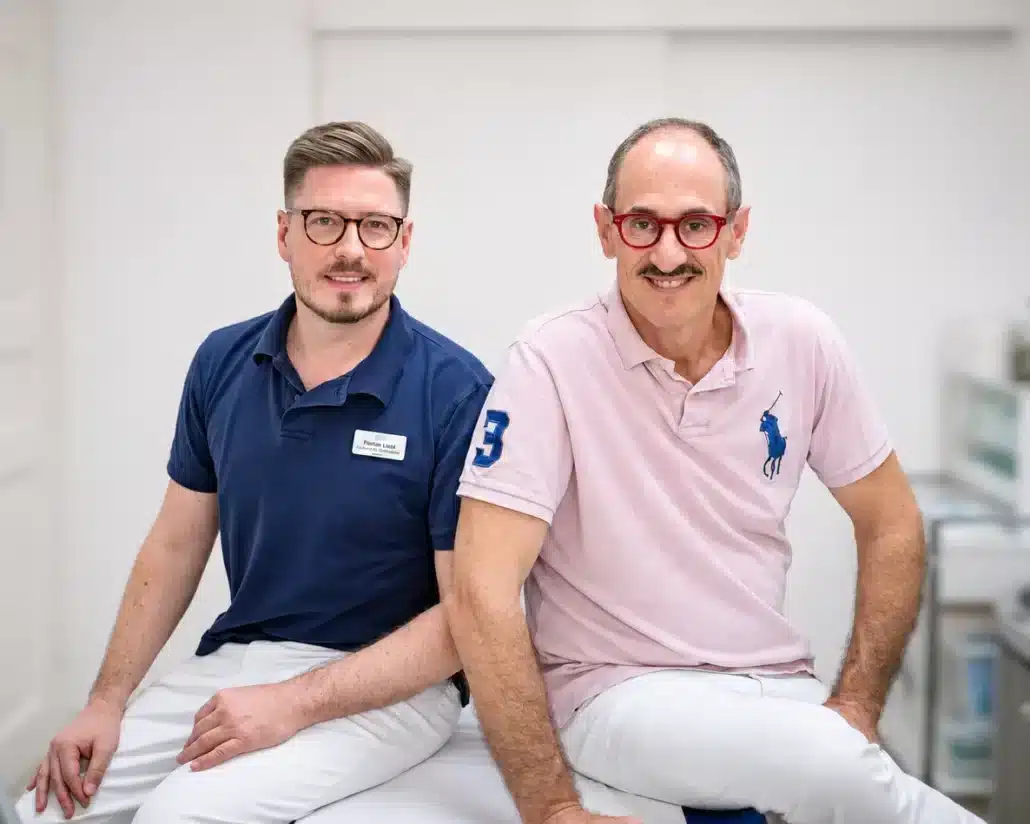
Dr. Bernhard Hofer has been refining minimally invasive treatment with pit picking and laser since 2004, building on the approach of Lord and Bascom: instead of cutting out large areas, we remove hairs and sinus tissue through small openings.
Florian Liebl, specialist in visceral surgery, adds reconstructive procedures such as the Karydakis operation for extensive and recurrent sinuses. This allows us to offer a suitable approach for almost every form.
Surgery is performed on an outpatient basis, under local or general anaesthesia. Permanent laser hair removal lowers the risk of recurrence.
Pilonidal Sinus Center Munich
On pilonidalsinus-zentrum.de we answer the most common questions about pilonidal sinus in detail. Most of these pages are currently available in German only.
What statutory health insurance covers and what privately insured patients can expect.
→ Read more (in German)
How you can support healing and what matters after surgery.
→ Read more (in German)
More than 80 clinical photos show how small the wounds are.
→ Read more (in German)
Why it helps prevent recurrence and how the treatment works.
→ Read more (in German)
Get in touch
The earlier a pilonidal sinus is treated, the smaller the procedure usually is. You do not need a referral.
